mineralmatters

Bauhaus

fig86-Robert-Morris-Box-Sound-Making-

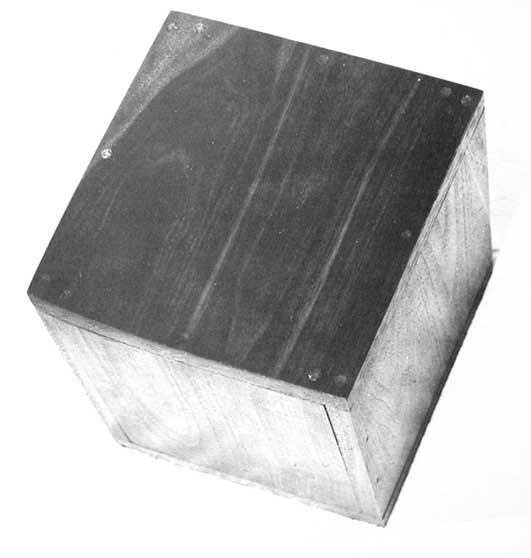
Labour forms a metabolic link between humankind and nature. There is our own labour – a labouring through the world that constitutes our everyday – and then there is a kind of labour that we read onto things. It is not very often that we are confronted by a stillness that cannot be overwritten by movement, or process. Function-less form makes no sense to the labouring eye. Some artists have deliberately materialized this vertiginous impulse. Robert Morris’ Box With the Sound of Its Own Making (1961), in which he installed a feedback-loop recording of the labour of constructing the box, within the form itself. Here, form is literalized as a carrier of functions. Some objects, like tools and instruments, give off a greater sense of immediate use, while ‘Do not touch’ artworks fall in at the other end of the scale. Paradoxically, traditional aesthetics has supplemented this distancing from touch by installing our metabolic reflexes within the act of looking itself, whereby mere witnessing is transformed into the act of beholding. This is a peculiarity of aesthetics that borders on a kind of fetishism (insofar as one sensuous domain is recruited to compensate for another’s withdrawal).

Bauhaus sought to rectify this fetishism by shifting the burden of representation back on to the crafts and practices that go in to production. This Modernist project realized what Douglas Crimp would later go on to theorize as ‘cultural practice’. (Interestingly, this shift occurred soon after Wölfflin’s Principles was published. Wölfflin pushed the fetishism of aesthetics to its formalist limit, by investing vision with the sculptural qualities of material praxis (i.e. he posited a vision that was able to penetrate and remodel physical attributes of the object).) Bauhaus failed because, although representation had been shifted on to the ethics of practice – i.e. the School – its utilitarianism was still ultimately subject to the production and display of objects (cf. the recent Barbican exhibition). Attempts to erase the object, to present labour in-itself, have multiplied in every direction since the day Bauhaus lay washed up on the shores of America. Most recently, Nicolas Bourriaud’s Relational Aesthetics and its theorization of participatory art projects presents a move to categorically replace aesthetics with ethics, as the correct backing epistemology for the production/reception of artworks. But even so, the same problem that arose with the Bauhaus remains: how to represent the event after the event and what to do with the audience. Instead, I want to chart and imagine instances where we, as spectators, have moved in the opposite direction. A situation where art objects become the raw materials to kinds of representative practices that take place beyond the gallery space. I want to look at the production of lifestyles as an unintended offshoot to the determinate blurring of the borderland between art and life. We no longer labour to survive; today we labour to look good. I want to locate instances that realize Bourdieu’s attack on Kantian aesthetics, instances where subjects maximize on their social capital. I do not intend to valorise the production of lifestyles from artworks, but instead the hope is that, by recognizing and pushing its methods and labour, we might be in a position to question the validity of practices that seek to redress the ‘fetishism’ of aesthetics with a well-meaning ethical commitment that – as I claim – backfires. By surpassing this commitment, I hope to draw the parameters of renewed possibilities for aesthetics today.
Stop Staring

My intention is not to lose sight of the object when standing in front of it. Even if passing currents and bleeps coax my stare sideways, to the wall; my hands: your face, I won’t look away. But the longer I look, the more the object keels under a cloud of images that sprout wrongly from my front step, that I want to call my desire at work but that, when I look again, are actually just my thoughts reclining morosely over the object, ready to go home. When you endeavour to fix your stare on something, it is already too late. We refer to judgment to repair this original missed connect. Our looking remains eternally blasé regardless of our eyebrows. Knowing something and then to see that something bask in that knowing is never total: there is always a particularised remainder, a something left behind that stops one from moving on. Or if you do decide to leave the scene, you feel the guilt of not fully accounting for, of not exposing oneself properly to, the materials in reach. Each one of those keen little moments of duration that cuts itself short to go to the toilet, take a phone call or keep looking elsewhere is met with brute time from the object’s direction. Why should time be so warmly sovereign in your hands but so cool in mine? If I had a hand in my looking I might know why. But the distance judgment requires to present itself as the recourse for a looking that always fails depends upon my hand’s disengagement. How can I make sense of those materials without my hands?

I want to fight back by taking the privilege away from my stare. The prolonged act of staring, I think, is decidedly the wrong kind of looking when it comes to art objects. To behold something without holding it is a refined disappointment I want to cut loose. So instead I suggest you walk blindfolded through the chambers with a trusty silent guide directing your step. And instead of looking, take such a small peep that, before you have even acclimatised to the brilliant light, your eyelid is closed and snuck back behind its cover. Now you can stroll onwards and witness and enjoy that first flash, and the after-image that follows, by using your tongue. These are the two moments of recognition, the beginnings and ends, that cannot be identified and subsumed by judgment, precisely because they are felt reflexively by both subject and object as a shared presence without form. If we judge form with our eyes, we communicate presence with our tongues. I don’t want to let looking take that from me, so stop staring.

Condensation

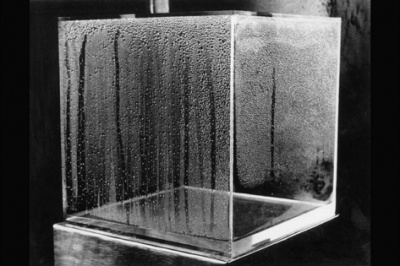
Hans Haacke, Condensation cube, Acylic plastic, water, 1963-1965, © Hans Haacke:VG Bild-Kunst

Hans Haacke, Condensation Cube, 1963-65

Condensation Cube is not a ‘sculpture’, but a hermetically sealed plexiglass box measuring 30x30x30 cm and containing a shallow, one-centimetre deep pool of water. In 1971 Haacke described condensation as a ‘real-time process’ designed  to relegate the viewer to the passivity of a ‘witness’[*]. He desired a situation in which the insentient ambience of nature’s ineluctable flux reveals citizen x’s Kantian ‘disinterested’ criticality to be nothing other than an interested compact with the ‘cultural frame’ lurking behind the work (which is itself always bracketed). Condensation here functions as a trigger, alerting the witness to the bland fact that her judgments can only slide off the work, which remains as disinterested as the world itself. Haacke targets the way in which citizen x normatively enforces her social capital by ab-using object x, via what Pierre Bourdieu has termed an act of ‘aesthetic distancing’[*]. By outsourcing the living object, citizen x feels herself as really belonging to the institution < I look over your shoulder>. Something, however, feels wrong with this Institutional Critique: it’s too good looking. The problem, as Robert Smithson declared, might be that ‘confined process is no process at all’[*]. This is not to say that Haacke unintentionally intends to sabotage his own critique by adhering to a central Minimalist motif, but that his refusal to acknowledge the iconographical presence of the Cube could be taken, by the selective vision of citizen x, to be a reverse encouragement of a Kantian disinterestedness.

According to Marx, labour is the metabolic process through which ‘man’ is connected to nature. It is only by labouring through the sensuous exterior world that we are able to realise [verwirklicht] our life ‘purpose’. I think, in order to salvage this critique, we must stop and think about what happens to form when it enters the gallery space. If labour is truly a metabolic process, it is also a mode of purposive movement we read into and onto still things. There is real living labour, and then there is labour that we presuppose through a kind of metabolic vertigo: we need labour to exist for things to exist. Function-less form makes no sense to the labouring eye. We depend upon the tactility of hard edges, of rules. As soon as the machine displaced labour’s sweat, and Capitalism supplanted nature as the world’s noise – at least that’s what the noise on the street feels like – our basic metabolism was re-calibrated, I would argue, to occlude labour, and to promote instead frieze-framed representations of one’s lifestyle as the process to which we must succumb in order to make sense of the sensuous exterior world. From the dissolution of the barrier between art and life, this new metabolism has been legislated and furthered by aesthetics and then communications to such an extent, that we now know nothing else: We no longer labour to survive, today we labour to look good. Could it be possible that an upwardly-mobile, interested citizen x might intentionally assume the lackadaisical face of disinterestedness so as to be artfully transmogrified into the object’s laboured nucleus, knowing that the distance between object and body in space instantiated by classical aesthetics diffuses any ethical commitment to labour? It is my claim that Condensation Cube points up a lack of labour that exposes the witness’ metabolic rift. If aesthetically ‘lobotomized’ form acts as a carrier and compensation for our lack of physical labour, then what happens when that form starts to breath and sweat through its own aesthetic confinement? It is precisely because a ‘real-time process’ is launched at the viewer from the seat of aesthetical power – the cube – that it works, because it lures one into a Kantian disinterestedness that is then divested of its ‘neutrality’ and exposed to be nothing other than a bid to get out of work. Here the bourgeoise-homme-citizen is forcibly alienated by nature’s détournement on one of Aesthetics’ most valorised motifs.

It is only once we face up to ourselves as ‘non-beings’, as living lives without agency in the world, that we can start to collectively labour for the greater good of all.


[*] Hans Haacke, ‘Provisional Remarks’ (1971) from Institutional Critique: an Anthology of Artists’ Writings ed. Alexander Alberro, Blake Stimson (Cambridge MA: MIT Press 2011) p. 120

[*] Pierre Bourdieu, Distinction trans. Richard Nice (London: Routledge, 201) p. 26

[*] Robert Smithson, ‘Cultural Confinement’ [1972] from ibid.

Scaffolding

Some objects are intended as material supports to real-time processes that occur in and around them, processes like condensation, heating, tree-growth and asphyxiation (rope). Scaffolding, for instance, presents an architectural function, and is not normally considered a permanent fixture (unless you live on the base of Mount Etna, where the ground remains shaky). In fact, one tends to look right through scaffolding, as if it wasn’t quite there. Why is this? Our vision, I would argue, takes process and makes it a precedent over form. Painting, cement blocks, rainfall and wolf whistles are activities that accrue and bleach over the spectacle of scaffolding’s quietness at night. These real-time processes infect the molecular structure in front of us, so that the empty ladders and rungs, after working hours, seem peculiarly out of place against the stalwart building they are there to support. Earlier, I asked the question: What kind of material and formal properties might adequate to Hegel’s outlining of a Synthesis that suspends the moments of its negations; of a Being and Becoming entwined in Stasis?[1] My response would be that a formal structure specifically designed to act as a material substratum to some kind of real-time process (whether it be a sauce-pan or a length of rope in the hands of an Alexander McQueen), is always ineluctably written over by that process, so that a cold pan starts to quiver from a ghostly heat, and its silvery lining appears starched white. Empty form is a carrier for you or me. We relate to the sensuous world by projecting our self-consciousness into things. When we promote forms to ‘thingness’, they are from that time on really nothing but ourselves taken outside of ourselves. I am interested in finding ways of obliterating this kind of solipsistic world-negotiation, by wondering how a real-time process like condensation can actually countermand and take on the subject’s ability to transform form into a mirror. In other words, I want a situation in which condensation takes on the role of you/me, in giving the saucepan its thingness, its static becoming. How can a real-time process have the power to relegate the viewer to a witness, forcing her to stand outside the ring of an object (not a thing’s) own life force? And why is this different to asking whether a falling tree makes a sound in the woods, if no one is there to hear it? Because, I am interested in a situation where the subject is coerced into recognising and reckoning with the force of process, to the point where subject-hood is irrevocably undone. Skeptically, one may reply that, once you begin to depend substantially upon a real-time process to forward a directional agenda – the obliteration of you/me – that process is reified in turn, and becomes another component of the subject’s recruiting of the world. In my next post, I want look at how one artist, Hans Haacke, attempted to use a real-time process to smash through the subject’s relentless insurgency of form, with a work entitled ‘Condensation Cube’, from 1963.


[1] In the Phenomenology of Spirit [1807], Hegel presents a world-view (weltanschauung) in which Spirit precedes Nature. This is a world where objects remain senseless until we have made sense of them, where objects depend upon us for their subsistence. In this situation an object’s being and becoming refers to the internal self-movement of spirit only we can give life to by admixing its senseless matter with our own material concepts. My question is whether real-time processes could take back the sovereign role of animating static matter with the life force of a becoming, by exposing the origin of our ‘spirit’ in the abstract thought of non-being.

OIL

OIL is not an object, nor is it a commodity. It is a naturally occurring substance, the self-formation of which follows the same processes as that of the commodity. It is a consolidated distillation of millions of years worth of compressed matter and organisms like you or me (the dead labour of accumulated time). To that extent, oil is a matrix for everything: the world distilled. Oil materializes and makes real the Kantian claim to open access and universality (insofar as it includes you or me). When your expression is countenanced and reflected by a pool of oil, that is time moving forward looking backward. The visual phenomenon of oil, I would argue, sabotages and scrambles the networks of economic and social capital that circumscribe the individual bourgeoise-homme, reducing him to an infinitesimally, incalculably small and irrelevant droplet of oil-to-come. This is a metaphysical attack and a good thing. This is the moment when the Sublime is reclaimed by Mother Nature and launched back at the constituted subject, to invert what happens in the sublime moment – the flashing undoing of the subject in the face of the object followed by the return of reconciliation. (Here the reconciled subject is permanently undone). OIL presents a premonition a thousand times more gruesome than the guillotine. More than death for the individual, oil presents the death of species human. That is actually, our DNA splayed out and squelched together with the DNA and membranes of countless other, taxonomically unregistered, things. OIL is a giant soup in which one human life-span of life on Earth constitutes one drop. And now consider the fact that the world goes through 88 million barrels of the stuff a day.

Exercise

What happens when the work of art – that ‘expensive hunk of well-regulated area’ – is outwardly emptied of its metaphysical content, the ‘content’ we prize beyond surface materiality – wood, steel, stone – and above the ‘visionary’ artist’s actual imprint? [1]

What if, instead of treating this material surface as a translucent screen to be peeled away, revealing the valorised quota of ‘universal truth’ contained within but, crucially, not equal to, the object’s outward form, our gaze and judgment purposefully, deliberately, rested on the surface: spreading a shimmering coat like an exquisite pond skater?

Could we purge our vision of its iconographical training, its tendency to metonymically enlarge from an object’s historical allotment, whereby a Judd cube sculpture cites a Piet Mondrian painting which in turn catalogues a set of colours and shapes, thus channelling a tactile model of vision predating modern history etc. etc. etc… What if, fatigued by our impulse to auto-genealogize when face-to-face with a work (because it makes us feel comfortable and clever), we made an attempt to close down this lexicon of inevitably unfolding image-signs, and instead, unnatural though it may seem to be, relax our expert eyes, allow our gaze to float upon the textured surface whilst making an effort to go no further.

We skate, eyeing around the brushstrokes or concrete, seeking some kind of entry-point into the work. But no! We do not want to lose ourselves in the object, to be returned transformed and inflected by the artist’s nurturing vision. That is not the point of this exercise. Instead, keep circulating, keep moving and, by suspending your gaze a millimetre-length film from the actual materials of the object, pond skater that you have become, you might be able to keep hold of whatever agenda you call your own.


[1] Farber, Manny, ‘White Elephant Art vs. Termite Art’, Negative Space: Manny Farber on the

Movies, Praeger (1971) p. 135

Questions

Through tracing the unique ontology of the art object as it persists now, I hope to address such aporetic questions as: What is the value of aesthetic value today? What kind of universally normative conditions can still be asserted as a priori for the situation of aesthetic engagement, when the self-critical artist increasingly seeks to engineer specific conditions for the reception of her work? Could (the labour of) spectatorship be shifted from the sphere of reception to the sphere of production whilst maintaining the aesthetic distance of non-participation? How can we restore the haptic to visuality – thus grounding an appearance long ephemerized through mechanical reproduction and smart phones – whilst refraining from actually touching what is there in front of us? Could the epistemological categories of Kant’s 3rd Critique be reworked and relativized to account for the specific social subject, by engaging recent developments in the field of queer phenomenology? Can the ‘aura’ be salvaged by moving away from a conception of the object as a moment in the life of the sovereign subject, to a situation whereby the subject is countenanced as a moment in the processual life of the object, (in line with Adorno’s theory of reconciliation)? What kind of material and formal properties might adequate to Hegel’s outlining of a Synthesis that suspends the moments of its negations; of a Being and Becoming entwined in Stasis?

Mineral life obliterates scale. Is mineral life therefore powerful enough to smash through the subject’s sovereign gaze, and if so, how can we put this natural force to use?