mineralmatters

Macchia

‘Macchia’ is an Italian word meaning spot, daub or otherwise mote. This word was taken up as an aesthetic idea by the Macchiaioli painters of nineteenth century Tuscany, whose painterly eye mirrored the formal concerns of the French Impressionist School but claimed a separate tradition. For these men ‘macchia’ linked the first sighting of a landscape to the painting’s final gloss. Sight and gloss are two poles that delineate the jurisdiction of mimesis. By presenting a historically distanced object up close mimesis permits painting’s gloss to ascend over the markings of sight to furnish the facing subject with an originary scene. Here gloss acts as a go-between that slips deferentially from view once the subject has secured a judgment—a judgment that feels closer to the sense making of sight than the determinations of thought because it takes possession of gloss’ effect.

‘Macchia’ is not a physical mark per se, but a marker of reflective judgment’s possession of gloss’ worldly equivalent—first sight. The Macchiaioli encrypted this sight through the auto-execution of a preliminary sketch. The unilateral compounding of gloss and sight denuded the seriousness of the spectator whose absence from the world was suddenly and visibly felt. Though mimesis’ curtailment was shortly perfected by photography’s index, the painter might be seen to have found the punctum first.

Foil

The casting of a judgement, which could be illustrated by______a Coke Can categorically not un-denting itself under some thumb, as______a reflex backtracking to a web of desire that ferments like chicken stock. (A web which is not really ‘pure’ but an accretion of that Can–(re: hard & twisted & pointing metal foil)). But you say the Coke Can is now the foil to this web you cast?

Judgement is determined turning backward. OR//look up the matter’s metal first.

Empathy

Empathy, as I understand it, is an emotional enterprise whereby one subject projects herself into the shoes of another, to inspect and make sense of the other’s thoughts, feelings and pain. Although intrusive, this paradigm of emotional intelligence shares common grounds with sympathy. Both depend upon a second party. To sympathize is to shore up one’s own sense of normalcy by recognizing and staking out the other’s pain. Sympathy is an exercise in reserve: not a reflex but a reflection, it amounts to a non-action. Empathy moves beyond this restrained partiality. When one empathizes, both parties temporarily lose their moorings and move into a state of flux. One subject is weak, recessive and receptive, and makes room for a second subject, who is stronger, more confident, and capable of investigating the pain of the other while holding on to an unguarded or unmoored ego. Sympathy is static and self-shaping; empathy moves where it pleases, shaping things outside of itself.

In terms of dynamic energy flow, the sympathetic subject sucks its principium individuationis from the pain of others (even while offering assistance).  In this negatively constructive way, the sympathetic subject makes sense of herself as relatively well off and self-sufficient. Sympathy is vampiric; it capitalizes on things. By contrast, the empathetic subject takes self-sufficiency as her starting point, is adventurous, and comes closer to the drunken self-forgetting of living in the beyond than sympathy ever will (which fears a loss of self-sufficiency). Sympathy shelters the scared self, while empathy advances the brave subject. If sympathy uses the bodies of others to make sense of its own body in space, empathy projects its body in space into the bodies of those around it. Sympathy presents the fragile body’s desire to formalize the disembodied strength of mind, and is a thinking feeling, while empathy designates the mind’s desire to assume the shape of the other’s body, and is a kinaesthetic feeling. If sympathy discloses the drive for form, empathy must be the shout of feeling.

STURTEVANT: ‘LEAPS JUMPS AND BUMPS’ @ SERPENTINE GALLERY, LONDON

MG_3584-1

Imagine you are Beatrice (you can be whoever you want to be). Now imagine that Hal Foster has led you on a tour of Dante’s Inferno and you see Tantalus sucking on a Diet Coke. That is what Sturtevant feels like.

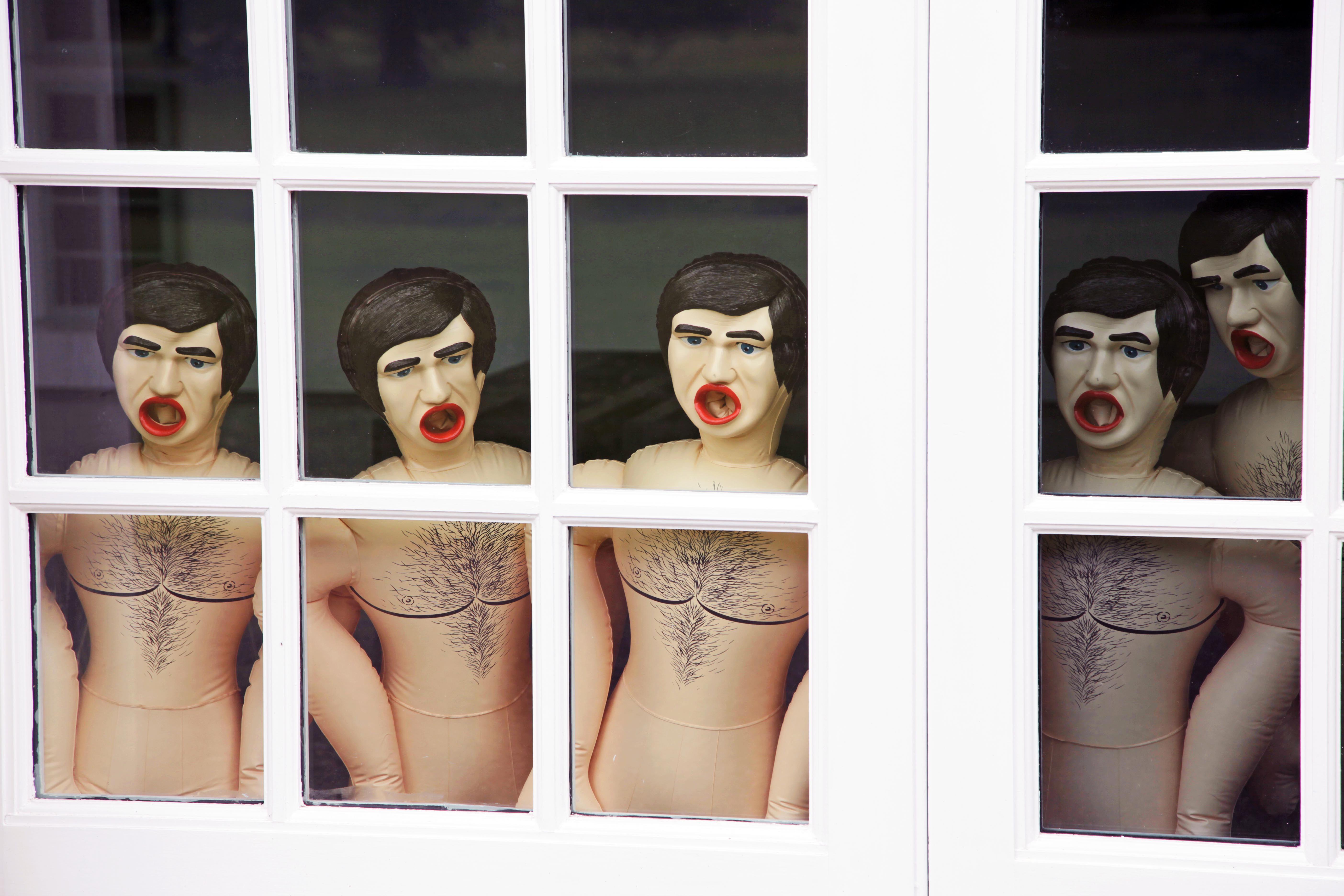
Approach the Serpentine Gallery cross country and you might spy a regiment of plastic blowjob dolls pressed mournfully up against the glass panes, looking very much like the cast of Pasolini’s Salò wallowing in a Neoclassical fish tank. But what exactly are they trying to escape from, the art? To the show: In many ways, this exhibition is a condensed tour of 20th-century art – albeit a Las Vegas-style, facsimile version… Just to be clear, that last line has been [lifted/hijacked/appropriated] from Alastair Smart’s review of Sturtevant: Leaps Jumps and Bumps published in The Telegraph on 30th June 2013. It is both usefully indicative of the work (the ‘tour’ bit) and an example of a pejorative line of criticism we can dispense with right now. Instead of writing this show off as a bite-size historical simulacrum dreamt up by Baudrillard (a.k.a. not Sturtevant), let’s think about what happens when you re-people an event that has in some unnerving way already past its expiry date.

An original thing to know about this artist is that she has never displayed a wholly original work, ever. This makes it hard to talk about Elaine Sturtevant’s output in terms of objects. If anything, the object you see in front of you – whether it be a reproduced Andy Warhol silkscreen or an adulterated Duchamp – is only really the ‘cashing in’ of an original ‘Untitled’ [Original] that is itself gapingly denied. In critical actuality, the surrounding work falls closer to event. Still, we are not invited to participate in anything other than a menagerie of aesthetically prostrate objects. It is like rocking up to an avant-garde Bar Mitzvah, only to find that the party is already over and the guests have all gone home: you decide to take a seat anyway.

The first thing you notice as you walk through the doors is Félix Gonzáles-Torres’ light strings. Brilliant, FGT always wanted these to be moved around and left hanging whichever way… If retroactive curatorial recuperation is an option here, it is certainly not made to be attractive. The bulbs spill out in fat piles that light up a low-res JPEG of an owl, serially smeared up and down the walls. Skirting around this botched interior design job (it is OK to say Art is something other than itself), you now come up against Elastic Tango (2010). An inverted pyramid of monitors mimetically beams forth spliced images, crosscuts, verbal breaks and affect siphoned off from other works around the show. It looks a little like the Holy Trinity mutating into a schizophrenic talking head that can’t process its own post-internet jingles.

Objecthood veers close in this room. Nineteen monitors, some boxy, some flat, converse behind the backs of sixteen Italianate, hairy-chested dolls. Shut your eyes and you hear (simultaneously) a gaming arcade; a 90s breakbeats compilation, cartoon laughter and, from the following room, the drugged thump of a nightclub. No wonder the Sex Dolls (2012) want to bust out, they’ve watched too much television. Hal Foster turns round and calls this a clean death: I don’t get the joke.

To enter Room 3 (the club) you must first walk past Warhol and Duchamp, who muscle in like two NeoCon executors (the bouncers) checking to see whether you know them (the I.D.). Looking around, the sunny park crowd looks mostly confused. Walk through: a 360º rotating projection of a criminal burlesqued by Joseph Beuys and later filched by Sturtevant lags dolefully behind the beat. Is Dillinger Running Series (2000) really just the metabolic vertigo of an art history consuming its own Style, like Ouroboros and its tail?

Finite Infinite (2010), the final work of this show, peacefully capitalizes on this anxiety. A dog sprints blithely across four projectors ad infinitum. With every looped repetition, the spectacle’s rhythms tighten and harden into an allegory that, like Sturtevant’s show, willfully proves the double paradox of witnessing after the event: the desire to reclaim and the need to mourn.


Archive

IMG_1248

IMG_1252

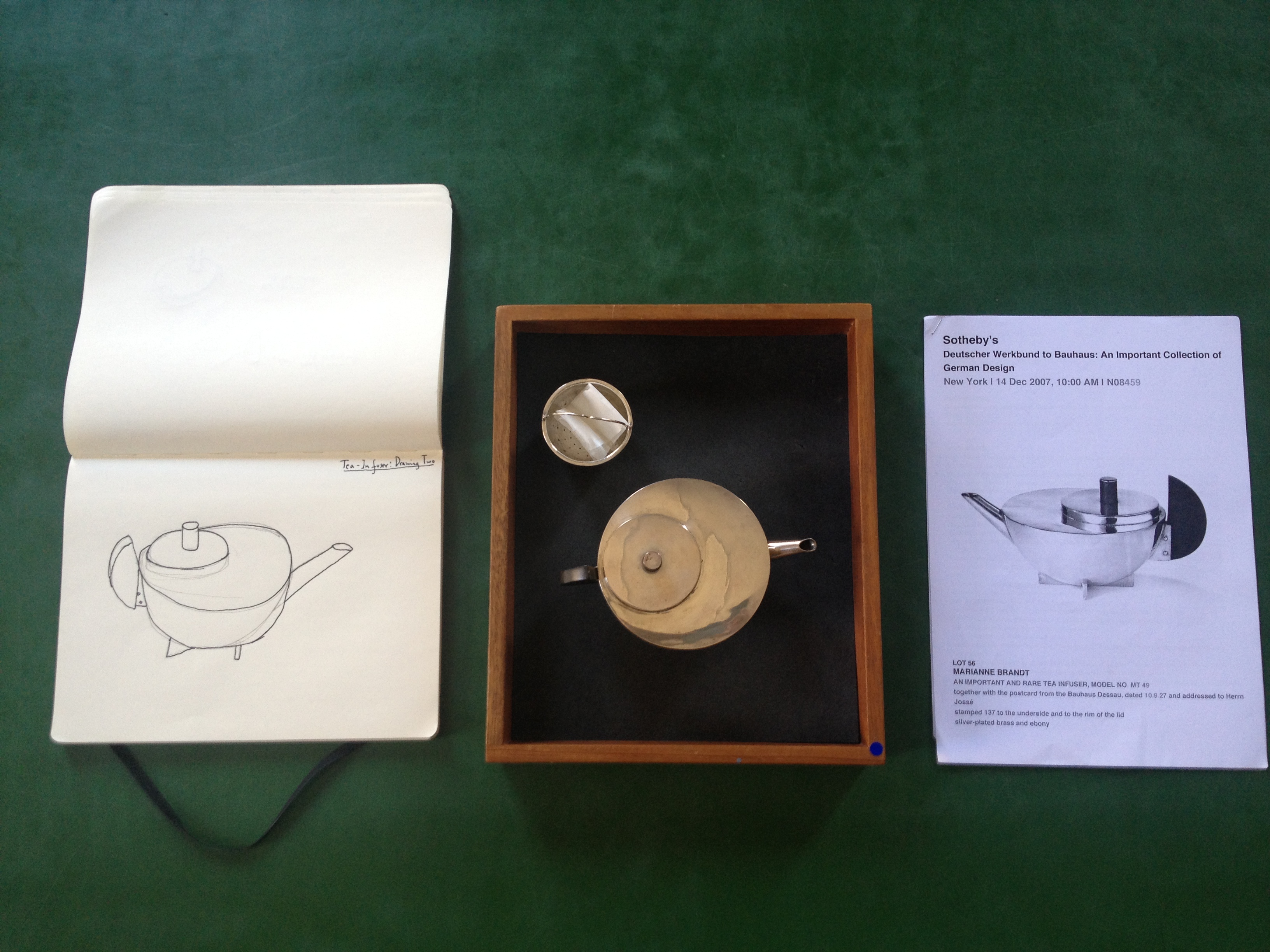
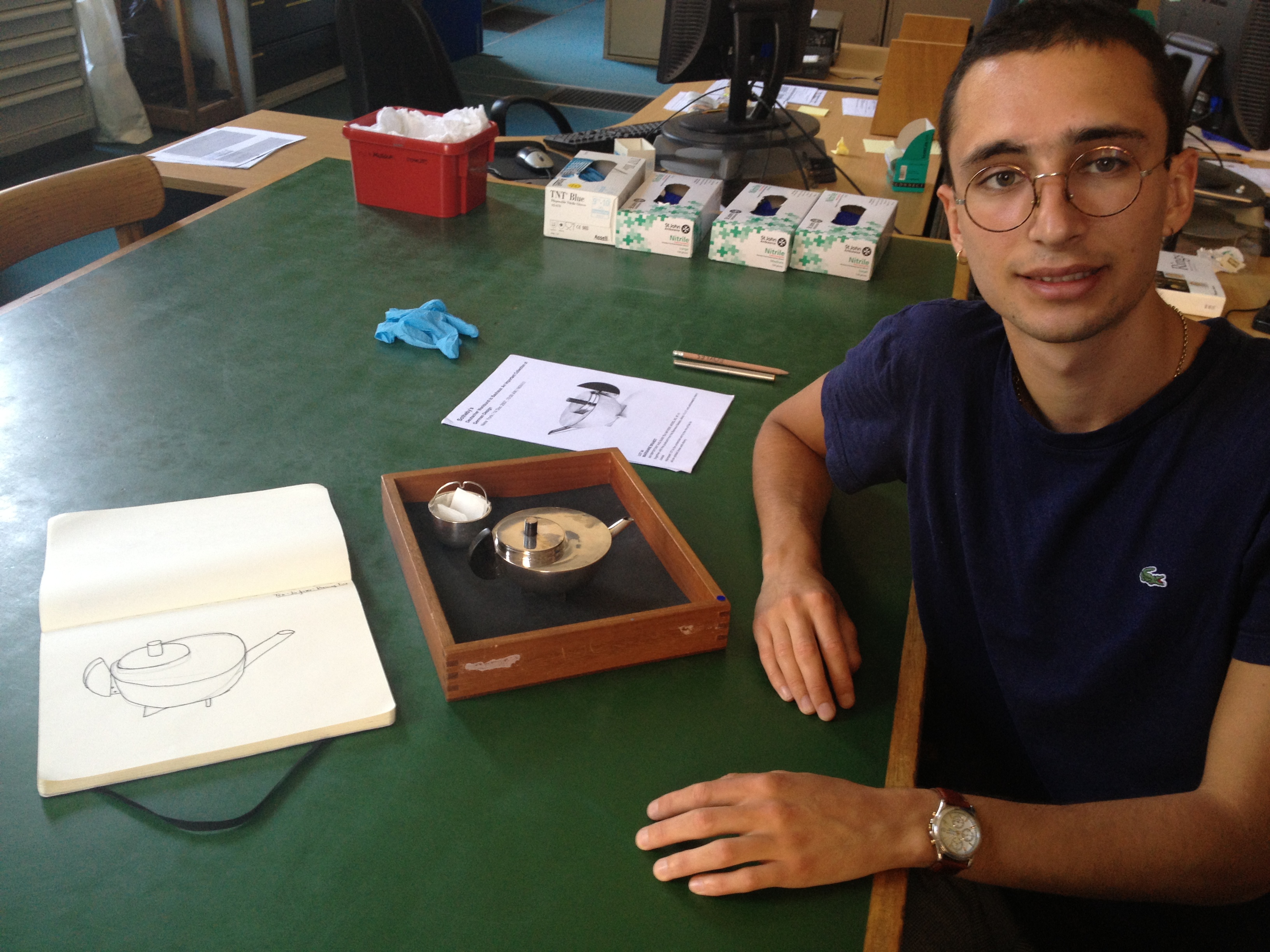
Visit to the Prehistory & Europe Study Room at the British Museum, to see Marianne Brandt’s tea-infuser (1927).

After signing the visitors’ book, I was led through to the study room. There on the table lay the tea-infuser in a wooden tray. I filled out some forms and sat down in front of it. Not being able to touch and hold the tea-infuser, I started to make drawings of it instead. There are seven proto-types of the tea-infuser in existence. Five of them are silver-plated brass, while two are made of pure silver. This tea-infuser is one of those two.  You can see the hammer markings reflected in the sunlight, and slight stains from the silver polish. The tea-infuser is much smaller than I expected. There is room inside for maybe one cup’s worth of tea. The handle is fragile, and the curator has asked me not to put any weight on it. The main vessel forms a semi-sphere, while the lid forms a circle. This circle is slightly asymmetrical when seen from above. You can see at the base of the spout that it has been welded together, in the metal workshop at Bauhaus Dessau. When looking inside the vessel, the hammer marks become more exaggerated. There is a high contrast between the beaten out, matt interior, and the shiny, smooth exterior. The spout is small and stubby compared to the main body, and helps sustain the form, whose concentrically and progressively enlarging circles would otherwise distend and stretch the form out unflatteringly. The handle, the lid-holder and the spout are all relatively delicate, tactile and inviting. When looking frontally across the vessel, it is clear that these three parts do not line up. The lid holder is placed slightly to the right, in relation to the straight line that runs from the handle to the spout. The tea-infuser is heavier than it looks. If you take liquid into account, I imagine that the handle, which is attached by two nails and glue, would only just be able to support the total weight. The infuser has been removed from the teapot, allowing me to see in to the vessel’s interior. Looking in, you can see that the inside of the spout has been lined with what looks like a black and dull insulating material. The rear of the spout has been roughly cut out into the vessel’s interior, and forms a diamond shape. The base of the teapot sits on four legs that jut out from underneath. These legs are only visible from the side, and cut a sharp right angle edge, against the smooth sphere of the vessel. The bottom side of the spout runs into the vessel’s downward curve, and appears at a distance to be part of the same silver metal. The handle is made of dark ivory, and is clearly pockmarked. The handle slopes organically inward, as if it has retained the impression of the hand that fashioned it. It is roughly cut and polished and appears to be easily detachable. The handle is a semi-circle that leans slightly away from the vessel, either through use or through design. I am not sure. The overall form is well proportioned. The compacted handle and spout work to stabilise the vessel, which otherwise would seem to stretch out in an accelerated manner. It is a beautiful design.

The Shop

Resident one comes down to the kitchen at 6am and reads a note she sees fastened to the fridge door. Letting out a yawn, she prepares a bowl of cereal taken from a cereal box belonging to resident two, who had left the house very early that morning. Five minutes pass before resident three walks sleepily in, wearing a dressing gown. The two residents who are present smile and blink at each other around the wooden kitchen table. Resident one starts to talk about the incident.

‘Have you seen that note up there?’

‘Where?’ replies resident three.

‘You know, there’, says resident one, pointing vaguely toward the note before diving into her bowl of cereal, not sure whether resident two was about to walk into the room. Resident three nodded indifferently, fished around her dressing gown pocket for a pair of smudged reading glasses and walked over to inspect the note.

‘I see… Yes, we could do with a shop around here. Right here in the kitchen. Do you know how pissy it is to have to walk up and down that hill every morning?’

‘What do you mean?’ resident one replied goadingly, ‘It’s not like you have anywhere else to go…’

‘Yes, well, all I’m saying is that, if I had the choice, I’d rather purchase my goods from inside, if I could. Directly…’ she trailed off. Silence fell across the table. Then, staring at the white bowl, resident three suddenly lashed out, as if just spotting something, ‘How can you filch her cereal? You know how hungry she’s going to be when she walks through that door.’ There was a pause, and then as if to herself, she muttered in a different tone, ‘Any minute now, any minute…’

Resident one smiled and creased her eyebrows before dunking her spoon back in to the bowl, to scoop out the last bits of cereal. They ignored each other.

*                        *                        *

‘Come here, darling. Come here’, resident three whispered a few minutes later. Nothing happened.

She bent down, and made some kissy kissy noises. Still, nothing happened.

‘Come here dumpling, my little sweetheart, come on.’ Nothing.

Resident three squeezed the back leg of her chair, reassuring herself. Resident one squeezed the back leg of her chair, annoyed.

‘Why don’t you come here, what have I done?’

Resident one, annoyed, drops her spoon. ‘Enough! Enough of your silly smoochy rhetoric, I’ll do it OK!’ And with that, she pushed the bowl away from her, got up and walked out of the room.

Resident three looked morosely across at the milk-lined bowl — she could hear rustling noises coming from the room upstairs. A few minutes later, resident one charged indignantly back through the kitchen door, returned to her wooden seat and set down a low, wide plastic container on the tabletop.  Opening the lid of the container, she started to organize piles of loose change. Soon she had counted the coins out in to neat little towers, which she then transferred one by one from the box to the opposite end of the table. She asked resident three to oversee the process.

Dictating in a pronounced and even voice, she called out, ‘Pennies. Twelve. Two pence pieces. Twelve. Five pence pieces. Twelve. Ten pence pieces. Twelve. Twenty pence pieces. Twelve. Fifty pence pieces. Twelve. One pound coins. Twelve. Two pound coins. Twelve.’

Looking briefly up from her work, self-contented, she made an aside to her colleague; ‘I always keep a spare float on me, just in case I need to start up shop.’

‘G-d you sound like Mother Courage!’ snapped resident three, a little angry.

‘Who’s that?’ she glanced over, not listening, before taking up officiously from where she had left off, ‘Right, well what have we to sell then? Come on, I’ve done my bit. Did you make a note of the cash?’

‘Yes, twelve of everything.’

Resident three calmed down and began to look enterprisingly around the kitchen, before settling on the cupboard above the fridge. She got up and walked over, climbed awkwardly on to a high stool and pulled open the cupboard doors. There at the back lay a dusty pile of newspapers she had collected over the previous winter. She had meant to use them for starting fires, but the council had asked her not to. Apparently, their cooperative was situated in a “high density pollution zone”, meaning she was not permitted to light fires indoors.

‘Here’ she said, returning to the table, her arms laden with the great dusty pile of newspapers. ‘I don’t mind getting rid of these. I’ve got no use for them now, since the council came by…’

‘Right OK, well put them down here next to me.’

Resident one carefully arranged the yellowy-brown newspapers out in front of her, with the cashbox hidden discretely behind.

They sat down in their respective places. Breakfast was over now and they talked freely. They continued talking for a few minutes before the conversation ran dry. For a long while they sat in silence, looking expectantly toward the door, waiting. Around lunchtime, resident one got up to use the toilet, and asked resident three to take her seat. She returned in a couple of minutes, refreshed, and they switched back to their original seats without a word. Some time passed. At about 5 O’clock, resident one turned around and said, ‘Well, I think it’s about time we put these things away, don’t you?’

Resident three opened her eyes, looked up at the clock on the wall, looked back, and replied, ‘Yes, I think it’s about time.’

Just as resident one got up to put the cashbox and newspapers away, they heard the sound of a key turning in the lock.

‘Quick, quick!’ cried resident one, ‘put everything back.’

They waited in silent anticipation as they heard resident two make her way down the corridor toward them. As the door opened, they looked knowingly at each other, as if to say, “Business”.

Resident two entered the room and glanced quickly at them, before going over to the fridge. Opening the door, she bent down to the bottom shelf, pulled out a soft drink, got up and turned around to leave the room.

‘Wait!’ cried resident three, ‘Don’t you want to see what we’re selling today?’

‘Selling?’ said resident two, bemused.

‘Yes’, replied resident one, ‘Selling’.

‘Oh I’m sorry but I’ve just been out at work all day, I’m knackered and I don’t understand what you mean exactly. Can’t we do this tomorrow?’

‘Do what tomorrow? We’re about to close shop, there won’t be time otherwise.’

‘Right…’ returned resident two. ‘Well in that case, let’s talk about it on Saturday at the meeting, shall we?’ Hesitating by the door, she turned around as if about to leave, before quickly adding, ‘You know, there are some things that need to be discussed. You can’t just do whatever you want around here. I mean, who are you to start a shop in my… in our house. Just because I’ve been out working?’

With that, she quickly turned around and walked out of the room.

Resident three looked over at resident one. ‘Right, I guess we better pack this all away then.’

‘Yes, I guess so’, said resident one.

Sturtevant

Imagine you are Beatrice (you can be whoever you want to be). Now imagine that Hal Foster has led you on a tour of Dante’s Inferno and you see Tantalus sucking on a Diet Coke. That is what Sturtevant feels like.

Style, Stylisation

In writing on the historically gendered and class-ridden hierarchies of art production, the feminist art historian Griselda Pollock states: ‘women were encouraged to ornament every conceivable surface because decoration in itself suggested a refined, tasteful life-style.’ Ornament, surface, decoration, lifestyle. When you line these terms up, what you reach is an infinitely serene and plastic flatness; the kind of flatness that speaks directly to the planar, the canvas, the living room and the wall. What is it about this plastic flatness that so neatly neutralises and cordons off the practice of women artists at work in the history of art, leaving them speaking to the wall? The clue is in the last designation – lifestyle – which, while  conceptually consolidating it’s formalising antecedents into a pocketable nosegay that may be seen, felt and admired when tea is served (but never thought on), also serves to draw the line between Style and stylisation.

The first word, Style (an absolutism that includes everything from schools, periodisations, collective facilities, uses and abuses, appropriation, pastiche, theft, reclamation and progress) must speak to Art’s true life-force: which is (nominally) 1) the foregrounding of a play of contradictions 2) the contestation of surface value. In its forward-rolling repetition of the same in different guises, Style squanders and hijacks and breaks the limits of form (even before it has properly surfaced); and all in its macho race to represent an Idea (any idea). It might be unfair and wrong to say that Style is the domain of male artists, but this is exactly the point and the problem Pollock draws (of course the Modernist avant-gardes sabotaged and opened up the rights to Style, even while masculinities were impressed more forcibly than ever).

Now to the second word: stylisation. If Style regards the object only fleetingly on its master-quest of critical invention, the protocols of stylisation quite literally force the practitioner to the ground’s surface (‘Style’ from stilus [Latin] DEF: a stake; a pointed instrument, used by the Romans, for writing upon wax tablets’). Embroidery epitomises stylisation to the extent that it is ornate; concentrated; Manneristic. When holding a pillow up to the afternoon light, you cannot survey: you must scrutinise microscopically. Here, vision itself figures the hand-weary entrapment and social paralysis encoded within embroidery as cultural practice. Thus Style unthinkingly carves up and allocates space for the curtailment of women’s invention, to the self-pinning labour of stylised ‘living’.

If Griselda Pollock sought to difference the canon by stratifying male and female roles against the backdrop of Style and stylisation – as I claim she does – then it is not only the emancipatory politics of the public sphere that may be seen to have (incrementally) redressed the rights of women, but the Modernist avant-gardes (Bauhaus; the Arts & Crafts Movement; De Stijl). It was their reclamation and valorisation of handiwork-as-lifestyle, as the most effective way of putting aesthetic practices and ‘useless’ productions across to social use; that retrospectively (and maybe without even intending it so), opened up a lit-space for the critical inclusion and assessment of women artists. Considered in these terms, the micro-laced patches of embroidery that adorned and domesticated the ‘progress’ Style blindly engendered, might be read as the site of a feminist revolution.*

*It is exactly this designation of a ‘women’s art history’, of a curtailed site of resistance, that Griselda Pollock fights against. I am here merely interested in describing the slippages that take place between Style and stylisation; to see how they  can be put to work.

Empathy

Empathy, or Einfühlung, is something you must guard yourself against. When the empathic other looks at you with feeling, just close your eyes. Sympathy is fine: the kind where your eyebrows fan out in public and the distance between two bodies is registered as a space of difference.

Empathy, by turn, should be sensed for what it keeps discrete, a process of sensory acquisition. Meaning literally, that when standing in front of an object (the object of empathy is an object like Hegel’s slave), I hold my body in a certain way, with my weight distributed frontally forward. This kind of kinaesthetic poise is completely deliberate, and designed to empower the eye, which assumes the telescopic, nearly telepathic power of antennae.

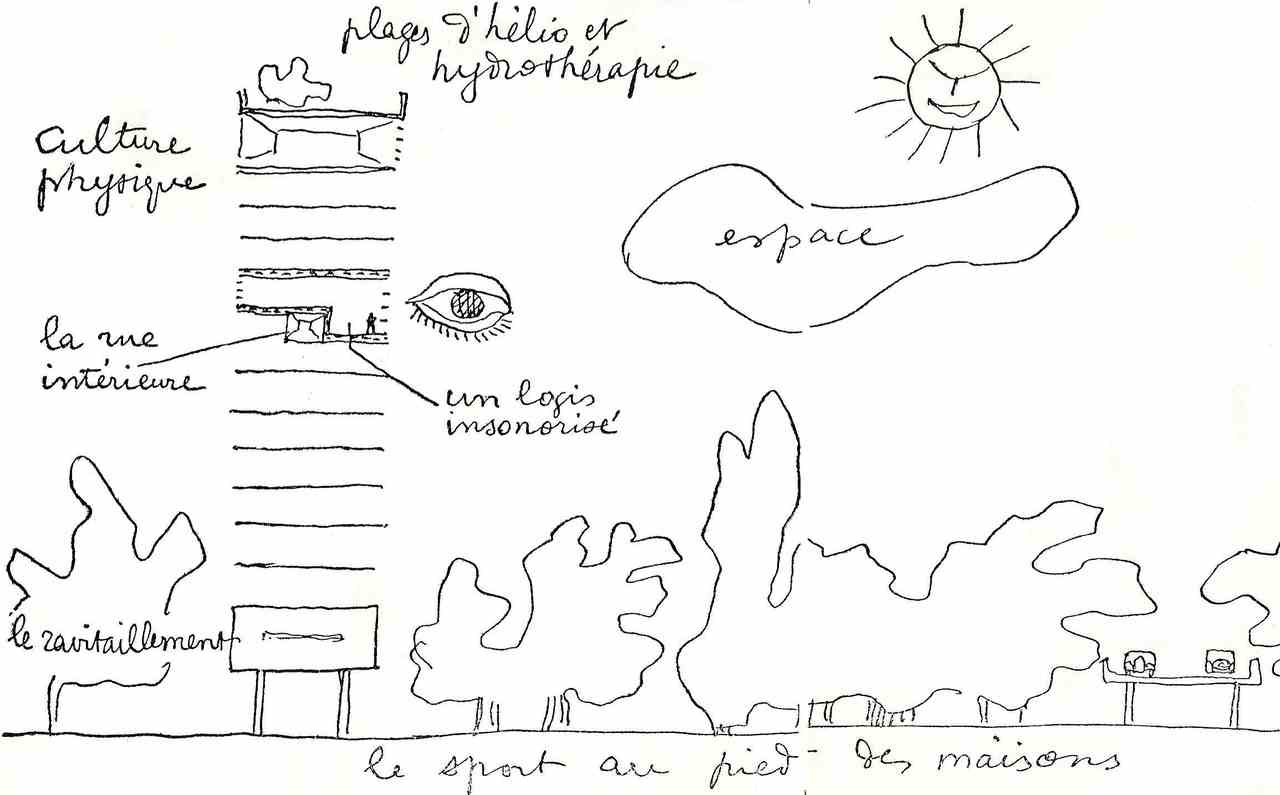
Process: the empathetic subject empties outward, discharging a burst of energy that shines up the spine, rattles through the antennae and, materializing light as a carrier of sight, cuts right through sympathy’s sovereign space of difference to penetrate the object of study. The act of empathy is phenomenological down to the ground. For instance, see Le Corbusier’s drawing of a stick person made mobile through the discursive extra-agency of a detachable eye:

tumblr_mbu4ypENR11rfxn8wo1_1280

Architecture is at the centre of the nineteenth century German aesthetician’s account of Einfühlung, because the scene of judgment (the scene of acquisition) is here not circumscribed by a frontal perspective. The empathic subject first learnt how to smuggle his emotions, intentions, agendas and designs into the object by wandering freely around interior space. Walking through close-packed rooms, or up and down stairs, the proximity of walls induces a kind of myopia that channels a surfeit of vision back in to the body’s skin, muscles and nerves. The empathic body is supplied its charge from this excess of vision, so that when it eventually stops stationary in front of object x, it has accrued the energy it needs to collapse a distance and smash through the object’s defences.

Domestic abuse is often not physical, and the alibi of ‘emotional support’ should be checked against the aesthete’s divisive fashioning of Einfühlung as an imagining will, or Vorstellungswille.

* Click on the image to enlarge.

Touching Feeling

Aesthetics is both a body of knowledge and a kind of practice. Either aesthetics designates an active engagement with the work of art, or it refers to the study of the constellation of affective states that directs this engagement. Aesthetics counterposes the spectator’s feelings about the object, with the way she should be feeling about the object. This disconnect derives from the Kantian distinction between the transcendental and the concrete thing-in-itself. By installing an interval of non-contact between our body as shaped in space and space as read by our body, Kant effectively split the phenomenal world into two pools that could be drawn upon to supplement one another, when needed. The first was shiny and perfect while the second was soiled and lived. On a local scale, Kant’s transcendentalism was figured in terms of the free perceptual play of the subject’s intuition and cognition, or reflex and reflection. This original distinction was merely legislative in pointing out the subject’s legitimate relation to the sovereign Form of Law: it was enough to know the balance of one’s behaviour against the moral concepts by which the body in space is circumscribed.

If the subject can position herself mimetically in relation to others through a shared lexicon of moral concepts <in the world of Kant’s public sphere we are all at least the ‘same’>, mimesis devolves to similarity when subject to subject relations are critically replaced by the subject’s relation to the object. If the former connection is figured through the discursive power of legality and legitimacy, the latter can only ever be known through the labouring difference of touch. That is why, when Kant progressed to his third critique and the study of aesthetics, his epistemological program had to account for touch by descending from its transcendental watchtower, to become a real, lived practice in the world. This would be fine, even good, if the bourgeois-homme-citizen was encouraged to spend his lunch hour stroking the cheeks of a Rodin sculpture before returning to business interests inflected by an experience of the beautiful; but instead, and probably with the museum’s red rope and glass panes in mind, Kant erased touch from the subject’s experiencing of the object altogether, and replaced it with a critically ‘disinterested’ distance. The logic for this disavowal was that, if touch continued to govern our relation to the object, we would only ever be able to experience a dirty pleasure, without ever reaching the Beautiful, which itself depended upon the object’s subsumption to the realm of moral concepts from which it could be transcendentally unfolded and impregnated by our understanding of the Good.

But what if we left all our moral concepts behind at the office, before taking a lunch break? And what happens to touching feeling, if disinterestedness straitjackets my body? Kant invested vision itself with touch, so that witnessing was elevated to beholding and looking itself becomes a material praxis. Vision is now the exclusive channel through which Kant upholds his transcendentalism, in the face of the phenomenal world, while touch has been clinically desensitised.

When the eye takes the place of the hand, when perception drags apperception into the room and refuses my squinting nerves, muscles and skin, I want to scream.