mineralmatters

‘S-105’ (Eva Hesse, 1968) and the matter of interpreting the “not quite artwork”

s-105_b

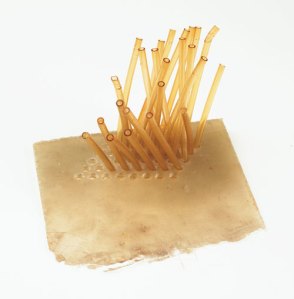
Eva Hesse, S-105. Fibreglass, polyester resin, plastic. Courtesy University of California, Berkeley Art Museum and Pacific Film Archive. Gift of Mrs Helen Charash, 1968.

This paper will risk interpreting a “not quite” artwork; that is, an artwork whose unclear status throws the work of interpretation into relief. Manufactured by Eva Hesse at her studio on the Bowery, S-105 (1968) is one of a series of “test pieces” that were posthumously consigned to the estate. In 2010, the test pieces were newly designated “Studiowork” by the art historian Briony Fer, who curated a successful travelling exhibition of the same name. Consequently, this “not quite” artwork found passage to the centre of what Robert Pincus-Witten termed the “industry of Eva Hesse [scholarship]”. S-105 is hemmed in by the conceptual act of naming and subject to readings of mimetic inscription: What if this thing is my model of thought? enquires Fer. Thinking with Fer about how S-105 speaks to us from beyond its muteness, I ask the following: What can we do with the excessive material lure that haunts the questions we ask of the “not quite” artwork? I want to trouble the critical transmission of affect, understood as an unavoidable interpretive recourse from a material thing whose lifeline is, patently, the institution of art history. To this end, I shall conduct a surface reading of S-105 as it is mediated via Yale University Press’ catalogue raisonné (2006). How does the formal intrusion of this medium and its value-form actually manipulate S-105? My reading is indebted to Eugenie Brinkema’s programme in The Forms of the Affects (2014). Finally, and in deference to the Late 60s’ positivist grounds of dematerialisation, my argument is informed by the critique of Gillian Rose: ‘Which concepts does the object have ‘by itself’? It has the reified concepts of non-dialectical sociologies and philosophies by means of which the non-reified concepts can be derived’ (1978).

Art History and the Parameters of Image Studies

This title points in several directions. By opting for the coordinating conjunction ‘and’ it is suggested that there is no correlation between art history and image studies. At the same time, these two figures are shown to be in some kind of dialogue by the inclusion of the qualifying attribute ‘parameters of’. From this one may infer that art history – positioned first and unqualified – is not open for discussion but that image studies, through its referral to a single attribute, is. The implication that art history will continue to remain a stable entity irrespective of the parameters of images studies – an inclusion that indicates the basis for discussion – is belied by their paired coordination. As the parameters of image studies fluctuate or expand, the equal weighting afforded by the coordinating conjunction will by necessity give way to a relationship of exile or annexation, allowing one to imagine such eventualities as Art History beyond the Parameters of Image Studies, or Art History within the Parameters of Image Studies. The amorphousness of image studies is brought to bear on the established rank and purview of art history, whereby the stability of art history is thrown into question by image studies, whose credentials are stabilised in turn. This reading plots a narrative in which art history is forever behind us and image studies before us, yet to arrive. Yet the privileging of ‘parameters’ suggests that, even if image studies were to stabilise its disciplinary protocols contra art history, the forfeit would be a constant state of watchfulness or paranoia as the policing of boundaries takes over from the receptivity of a burgeoning state. An alternative to this would be as follows: Neither art history nor image studies are stable to begin with, or at all. Here, ‘parameters of’ points to the irrevocable chaos of the cosmos; that is, to an equivocal set of shared substrata that cannot be neutralised and can only, from now, be accounted for. As Georges Didi-Huberman asks, what if one “allows paradox to flourish”?

Book Review

John Paul Ricco, The Decision Between Us: Art and Ethics in the Time of Scenes (Chicago and London: University of Chicago Press, 2014). A review essay, co-written with Matthew Ellison for parallax journal.

http://www.tandfonline.com/doi/full/10.1080/13534645.2015.1022367#.VVCGTGTF93g

(iPhone)™ as Perpetual Keepsake

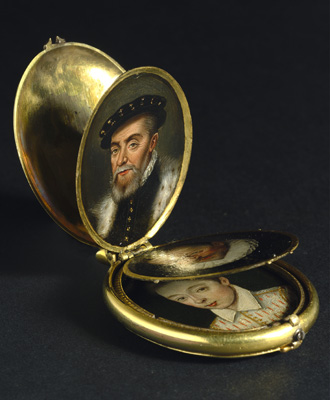
Dutch miniatures locketm

In this vacuum of sheets everything is so proximate that seeing things is a joke, but it takes two or more to fantasise with so instead I cup my iPhone.

Dutch eighteenth-century portrait miniatures contain a sheer density that fucks with other media as their sole purpose is to communicate gaze. Leo Bersani writes that “sexual desire initiates, indeed can be recognised by, an agitated fantasmatic activity in which original (but, from the start, unlocatable) objects of desire get lost in the images they generate.” Sometime else, the portrait miniature pretends the object of desire is locatable as it turns fantasmatic activity into a smaller, weaker object of desire that warms to the touch like the animal warmth of a hot water bottle. But there is something ocular in the crystalline sheen of its rounded surface that collapses the absent object of desire into the metallic realness of that object — a manneristic piece of the Western Tradition that only actually falsely promises.

Somewhere I am A.M. with the duvet doming overhead, and the metallic realness of this object is my real object of desire, because you can only be the images that you generate.

Gemäldegalerie, Berlin

t

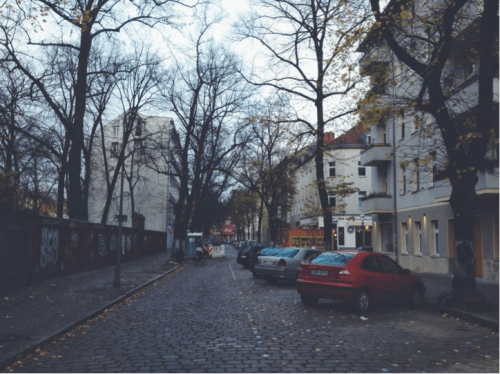
There are some portals in Berlin that reach out into the city and coordinate historical time. The Soviet Monument in Treptower Park is one of them. Its grounded range outsteps your step, like those Stolpersteine, or commemorative “stumbling blocks”, that persistently interpolate conversation with the image of a damaged subject–a subject who still breathes a geographical map through Neukölln’s swampy trees. This makes living here, in Neukölln, feel strangely drained of futurity. It is a place where time is governed by buildings, not people.

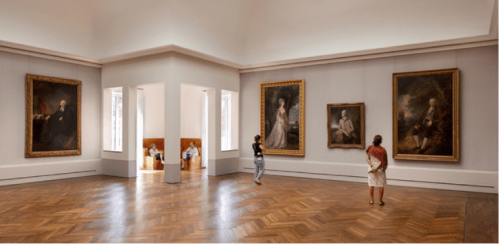
The Gemäldegalerie is situated in the Kulturforum district of Potsdamer Platz, just north of Schöneberg and the Landwehr Canal. A major art institution in Berlin, the Gemäldegalerie handles the majority of the State Museums’ collection of traditional Western Art and can be compared to London’s National Gallery, or to The Met in New York. It is peopled by an empty collocation of gallery spaces that surround a centrally elongated “meditation” hall; and the power of State lies in these rooms.

r

Upon entering the first exquisitely hung gallery one is addressed by a quantity of medieval iconography that deflects empathy. The first room is wooden and white and presents a screen that transports me to the forbidden upstairs of a synagogue in Westminster.

An invigilator stands directly underneath the lintel of a portal, its right doorpost hidden behind the cream skirting board of an intervening room. A former agent of the state, the invigilator’s hair is fixed in a bouffant whose peroxide is akin to the surrounding sacred spoils of the Moscow Patriarchate. Through the window there is a construction site where a yellow crane lifts a blue crate into the sky.

d

Through the window, the fixed lens of a Düsseldorf teacher instructs the collection’s old commodity-form. A group of schoolchildren walk past and the host of Maria mit Kind shine through their containment.

Sergei Eisenstein’s October (1928)

Screen Shot 2015-01-20 at 19.54.28

Screen Shot 2015-01-20 at 10.58.39

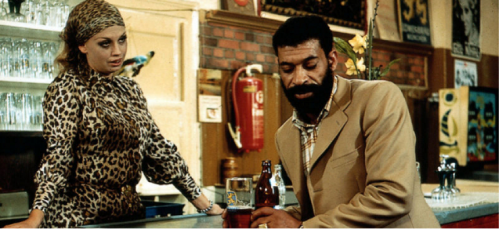
Sergei Eisenstein found himself in trouble with the Soviet government for an apparent “over-attention” to form in the making of October (1928). According to Stalin’s commissioning arm, the Russian people would not be able to understand the ordering of historical events surrounding the October Revolution of 1917 because Eisenstein’s attention to technique, angle and montage all interpolate too much form into the film’s narrative. Yet one can argue that Eisenstein’s punchy by-lines offer clear directives to the mass audience, who are confronted by the familiar story of the shoring up of Tsarist reserves, the wooing of the Mensheviks, the deposition of the liberal provisional government, and the climactic establishment of the Russian Socialist Federative Soviet Republic. Again, the figures of General Kerensky, Lenin and Trotsky (who was later excised altogether), are consistently identifiable against the film’s chaotic thrall of demonstrations, speeches, meetings and marches. Against this landscape of landmarks, therefore, Eisenstein’s formal work does not strictly detract from the film’s message and agenda. If anything this “making visible” of technology and the editing process enhances the production of energy that propels the train of historical events forward. What, then, is the problem of form in Eisenstein’s October?

There is one scene in particular, during the final section of the storming of the Winter Palace, which may have captured the Soviet government’s distaste. An unnamed Bolshevik revolutionary breaks open the door of the Princess’ bedroom, runs in to the centre of the chamber, and plunges the tip of his bayonet into an abundance of silken sheets. As he draws his bayonet vertically upwards, revealing the mass of down contained within, Eisenstein’s camera lingers on the revolutionary’s face as it turns in the direction of the Princess’ chest cabinet. The Russian people are invited to gaze upon a series of photographic portraits of Nicholas II, whose stateliness is softened and made familial by the private space of the bedroom.

The revolutionary’s ambiguous gaze is repeatedly broken and refashioned by Eisenstein’s camera, which switches to the ransacking of the Winter Palace’s lower quarters and wine cellar before returning, invigorated and charged. Still, the revolutionary is suspended in time, and the Russian people share in a precious display that is soon to be rendered obsolete. In one sense, this imminent obsolescence makes such a suspension of action desirable because the spectator really feels what it is like to participate in the levelling of value: the revolutionary’s reverie is instated as a moral position to be inhabited and overcome, and it is this recognition that makes such a scene permissible, even necessary, for a defence of Eisenstein’s realism.

However, and this is the crux of the matter as I see it, instead of witnessing the expropriation of the portraits of Nicholas II, the shot is taken over by an unnamed classical sculpture of a young girl that is suspended in a temporally unbounded space. This interval is installed within the gaze of the revolutionary alongside the mise-en-scène of devastation occurring in the other millennial rooms of the Winter Palace. Eisenstein’s camera then performs the connoisseurial movement of ekphrasis, tracking down from the veiled face to the exposed pubis.* Amidst the iconoclastic disarray of the governing action, this purely formalistic attention to the figure of a young girl transports the spectator to a space of contemplation that is, ironically, in the possession of one absconded class.

Did Eisenstein employ ekphrasis, a style of description tied to vision, in order to subvert the senses as well as the standing of the Tsarist elite, or has he redeemed them? Suffice to say, in criticising the excess of form in October, the Soviet government may have been momentarily piqued, by what was thought to have been put to rest.

* Ekphrasis here refers to the rhetorical description of a figure that begins from the head and moves progressively down to the ground. By employing this term, I want to point out how the camera’s movement, so out of keeping with the general ransacking, conjures the image of the connoisseur in his darkened viewing chamber: a subject who has been forcibly removed from the Winter Palace.

STEPHEN G. RHODES, ‘THE ELEVENTH HOBBY’, VILMA GOLD GALLERY, LONDON

Mark-Blower-141203-Stephen-G-Rhodes-Vilma-Gold-0042

Walk down Minerva St. in Bethnal Green and you will detect the crescendo of a Church organ locked into the armature of a contemporary art gallery. Like an intervention stripped of its divinity, this streeted goddess of wisdom; sponsor of arts and craft, magic and medicine, will be in residence at Vilma Gold Gallery till 24th January 2015.

The Eleventh Hobby is the latest offering from Stephen G. Rhodes, a Berlin-based artist whose practice is hard to place. In fact, Rhodes’ practice feels more like a contusion of places that mocks any person’s desire for sound judgment. Typically, this artist mines cultural fields in search of stuff that is obviously wrong or historically misplaced, and feeds the resultant mess through a mediatic tunnel of green screens and slipshod wooden constructions. The end product is consistently thrilling and troubled – think Paul McCarthy strung to an insomniac’s clock – and this showing is certainly no exception to the contumely.

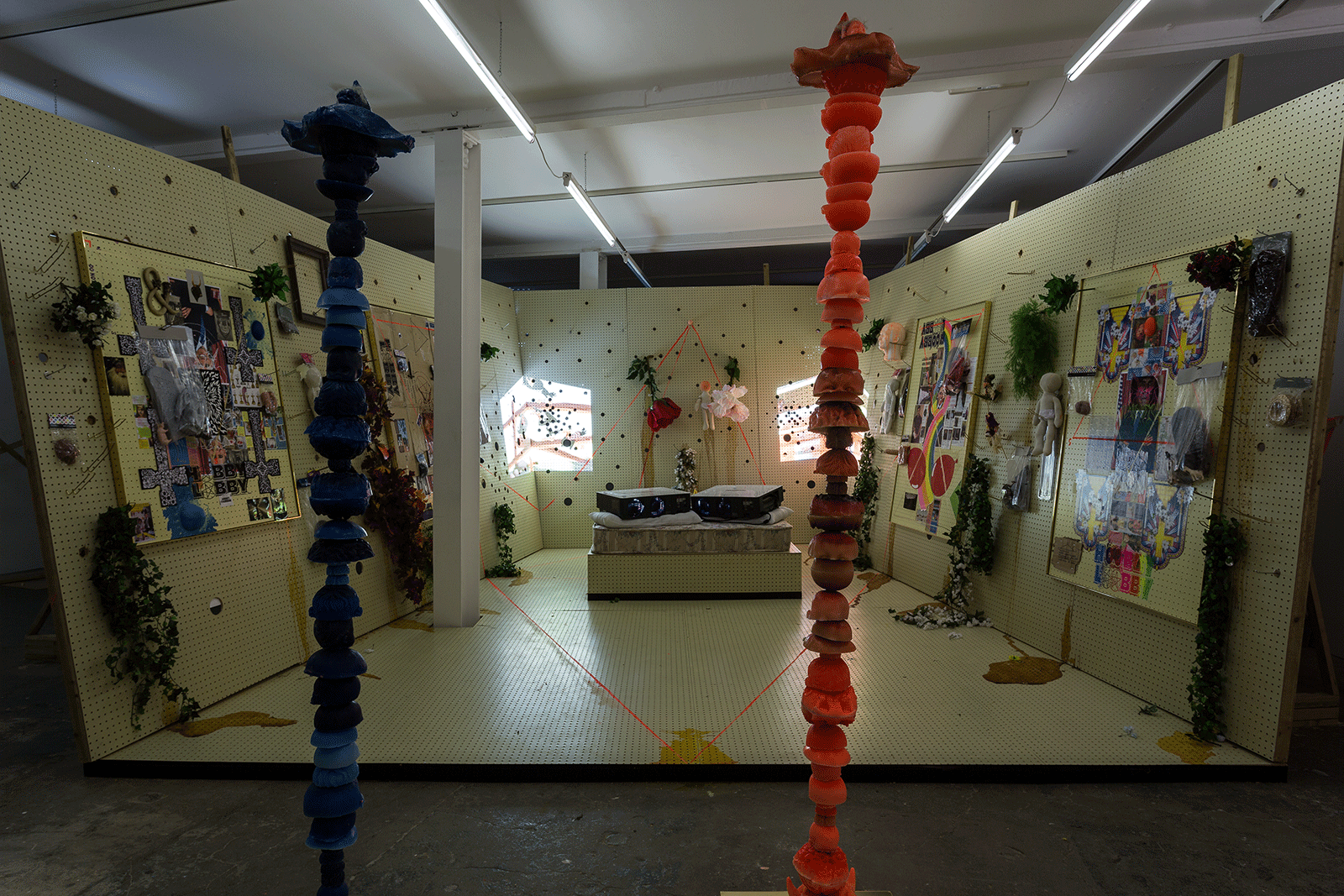
The Eleventh Hobby comprises a walk-in installation; two totemic floor sculptures; a series of wall-mounted collage works and, finally, a vertiginous loop that orchestrates your body like an in-store experience, drawing the host of discrete objects into one melodramatic play.

The exhibition’s title refers to Hobby Lobby, a chain of retail arts and crafts stores with headquarters located in Oklahoma City. Last summer, this family-run purveyor of leisure took offense to the Patient Protection and Affordable Care Act (2010), which enshrines unconditional access to the morning-after pill in company law. Hobby Lobby sued federal government after the U.S. Supreme Court quashed their lawsuit, winning temporary exemption through a loophole in the Constitution. Meanwhile another loophole is exploited on the other side of town, as The Church of Satan prepares to mount a statue of Baphomet mit Kind…

On the occasion of The Eleventh Hobby, Stephen G. Rhodes explores the identity of all loopholes through a multifarious address to the “Holy Trinity” of state, church and commodity exchange. The holier-than-thou Hobby Lobby is imagined to be of the Devil’s party, in what looks like El Lissitsky’s Proun Room fed through the basement of Berghain, or Oklahoma chewed up by Berlin. In the centre of the gallery space there stands a semi- fabricated shop, with pegboard walls housing a stock of replica commodities; including tiny voodoo-like mannequins wrapped in plastic, inverted crucifixes, rainbow motifs and scrapbook juxtapositions of vicar strippers and a repro Obama. Amidst this Black Friday window-shopping carnage sits a dilapidated generator-powered mattress set to “auto- hump”—a fitting altarpiece. Two erotically displaced projectors throw footage of a Hobby Lobby store interior, spliced with soft televisual hooks.

Rhodes’ customer is invited to walk around this self-contained installation, and by so doing, to enter into orbit with a Dantean circle of 60s art historical offcuts. Two floor mirrors swim anamorphically across the cast concrete; a school of surveillance pictures remembers Aby Warburg’s Mnemosyne Atlas with a nod to Rhodes’ détournement on this figure last year in Zurich; while the aforementioned projections jet through the pegboards’ circular holes, creating a filmic physiology in the vein of Stan Brakhage.

Stephen G. Rhodes’ The Eleventh Hobby recognises something seriously, insolubly wrong. It is funny in the way that American civil politics can be funny. But like the eternally humping mattress, the long night’s ease of laughter is quickly exhausted. Ultimately, this work is unremittingly realist because it tackles head-on the surreal logic of contemporary politics.

Book Review

Eugenie Brinkema, The Forms of the Affects (Durham: Duke University Press, 2014)

http://review31.co.uk/article/view/261/in-search-of-a-radical-formalism

Book Review

ReNew Marxist Art History eds. Warren Carter, Frederic J. Schwartz, Barnaby Haran (London: Art/Book, 2013)

http://review31.co.uk/article/view/234/between-discipline-and-practice

The Pillow and The Screen


 i. Labour // Work

What is labour? For Marx, labour is intricately bound with nature. It is our basic metabolism. The labour of locomotion, respiration and self-nourishment, of our own animal subsistence, brings nature so close that it permeates our bodies and skin. The world’s sensuous vitality forms the material substratum of our consciousness; it resides within our bowels and under our feet. To step back and witness this noise would entail a cessation of labour. But as Marx insists, we labour to belong. As a metabolic process, labour can either reveal one’s purpose through the production of vital activity within a ‘sensuous exterior world’, or it can consign one’s life to production for others, reducing the social agent to a ‘slave’ who only ‘feels herself freely active in her animal functions of eating, drinking, and procreating’. If we reverse these criteria, we see that humankind’s proper ‘species-life’ of free, purposeful activity can only exist after the full substratum of animal functions have been dealt with: we fuck our way to Paradise.

Yes, we labour to survive, but we also labour to flourish. The labour of living, of lifestyle and loves, tips this collective activity over the metabolic scales, into determinate forms of work.

What is work? For the political theorist Hannah Arendt, ‘work is the activity which corresponds to the unnaturalness of human existence. Work provides an “artificial” world of things, within its borders each individual life is housed’. Work is protective; it shelters the scared self from a world of unwarranted labour (from the labour of others). At the same time, work is clearly bound up with style. It is a style of being with oneself away from the work of others. We can therefore say that work partitions a world of subjects into a world of houses that face each other in rows. It is anti-political, anti-others. For example:

 ii. The Pillow

The feminist and art historian Griselda Pollock writes on the context of the nineteenth century: ‘women were encouraged to ornament every conceivable surface because decoration in itself suggested a refined, tasteful life-style.’ Ornament // surface // decoration // lifestyle. When you line these terms up, what you reach is an infinitely serene and plastic flatness; the kind of flatness that speaks directly to the planar, the canvas, the living room and the wall. What is it about this plastic flatness that so neatly neutralizes and cordons off the practice of women artists at work in the history of art, leaving them speaking to the wall? The clue is in the last designation – lifestyle – which, while conceptually consolidating it’s formalizing antecedents into a pocketable nosegay that may be seen, felt and admired when tea is served (but never thought on), also serves to draw the line between Style and stylisation.

Style squanders and hijacks and breaks the limits of form (even before it has properly surfaced); and all in its race to represent an Idea (any idea). If Style regards the object only fleetingly on its quest of critical invention, the protocols of stylisation quite literally force the practitioner to the ground’s surface (‘Style’ from stilus [Latin] DEF: a stake; a pointed instrument, used by the Romans for writing upon wax tablets). Embroidery epitomises stylisation to the extent that it is ornate, concentrated, mannerist. When holding a pillow up to the afternoon light, you cannot survey: you must scrutinize microscopically. Here, vision itself figures the hand-weary entrapment and social paralysis encoded within embroidery as culture practice. Style is what we remember after the progress of years. But this is only because it is the name that unthinkingly carves up and allocates space for the work of women’s anonymous toil.

My query and desire in writing here, is to find a passage back to the metabolism of labour through the anonymous toil of work. (And by so doing it is not my intention to reclaim embroidery as cultural practice.) Instead, I would like to reconfigure what labour means for us today, by salvaging and separating the cumulative routine of work from its rule of isolation. This means returning to nature (labour’s battery and end). And in order to do that, I must first describe mimesis: a category that pretends to substantiate our desires, by feeding them back through the enveloping (now receding) loop of nature.

iii. (Mimesis) Imitation // Mimicry

Mimesis is an Ancient Greek name that can be split into two related functions: imitation and mimicry. What is their difference? An imitation of nature points to a sympathetic representation of a subject of the world that is also (now, then) not of the world. That is to say, the subject behind an imitation (the embroider) has a narrow jurisdiction, and to try and stretch and expand her range would be wrong. At the same time, an imitation of nature (embroidery) is declaratively not the ‘real thing’ but an approximation. It is, in Hannah Arendt’s language, ‘artificial’.

Mimicry is imitation’s more playful side. To mimic someone is to learn by copying their actions, but it is also to laugh and undo them in the process. Walter Benjamin writes that ‘the mimetic faculty… remains closely tied to the commonplace, sensuous realm of similarity’. What, then, is the difference between forming an imitation and locating similarities?

If an imitation (which I am here linking to the stylized constraints of work) represents the object as an object upon which the sympathetic subject can only reflect, similarity disallows the disinterestedness of judgment, by molecularly qualifying the object against other living things in its radius. The formal task of naturalistic approximation is replaced by the open playing field of proximity. Similarity denotes an animal, labouring cognizance concerned with the attractions and repulsions that exist between separated masses: at no point does it seek to hypostatize what it senses into objects on display. Similarity reveals the object’s inner correspondence to a posited outside, which is tantamount to turning the object inside out, to dissolving its appearance [Schein] into a receptive mass that is not so much a closed harmony within an object as a harmony between the object and the subject. If an imitation presents the object’s perfect harmony with itself, similarity squeezes harmony porously out, into the politically acute, spectatorial spaces that exist between things and subjects. In other words, if an imitation sets the stylistic parameters for the work of the social subject (embroidery or otherwise), it is also a disciplinary tool that decides whom in society is permitted to do what where, in what way, for how long and at what time of day. Mimicry’s play of similarities labours to unlock the artificial housing within which imitation cordons the work of subjects through history.

Returning to the scene of the pillow, I now want to jump forward to the site of the screen, to spotlight and make sense of a labouring mimicry, forceful enough to overturn the work of imitation.

 iv. The Screen

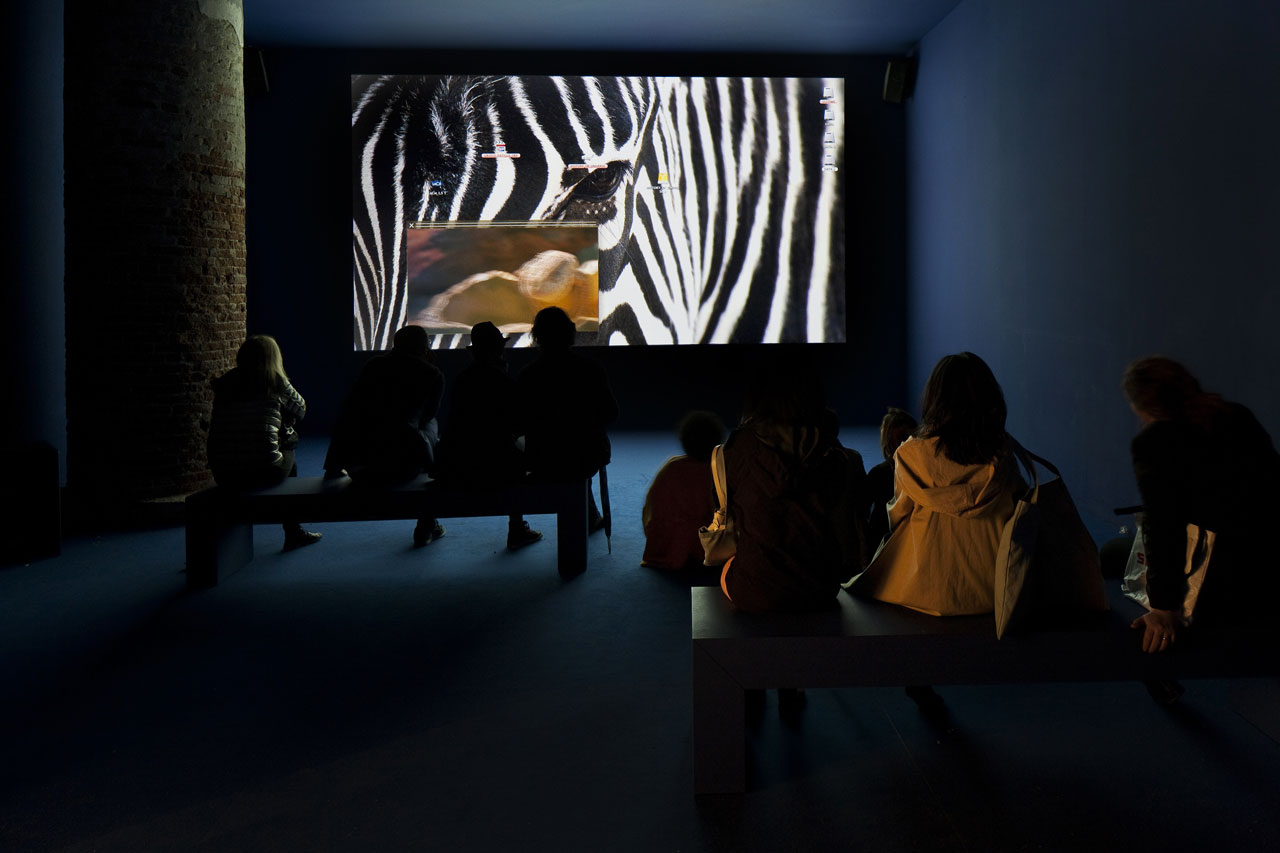
The contemporary French artist Camille Henrot recently  showed a video installation at the Venice biennale titled Grosse Fatigue (2013; Colour & Sound; 13 mins.). This work is the outcome of a residency Henrot undertook the previous summer at the Smithsonian Institute, in Washington, DC. Grosse Fatigue purports to present the ‘origins of the universe’.
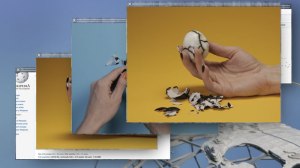
image_654_image_fr

henrot02

i-stills_-05-z34

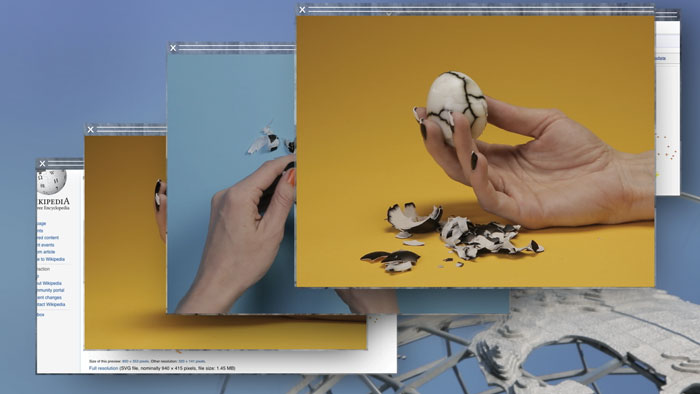
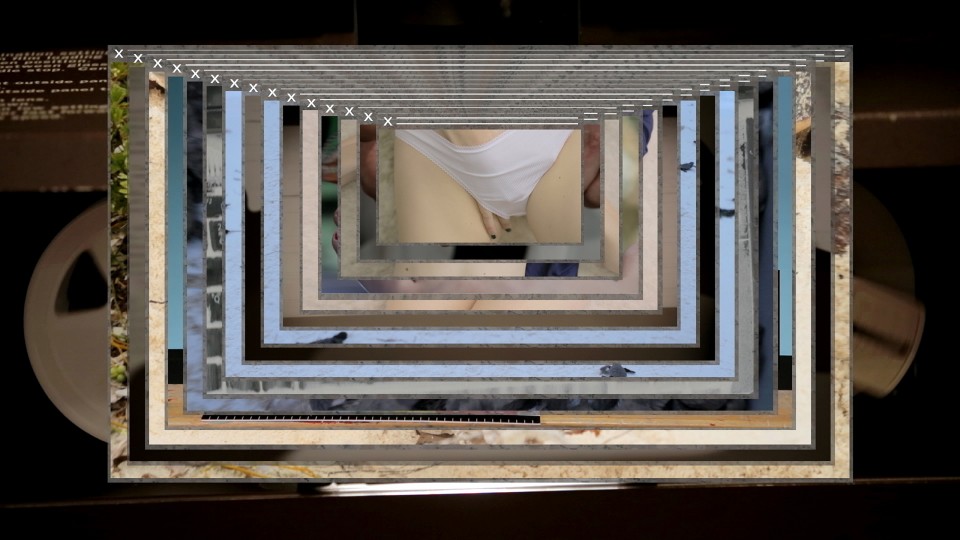
 A spoken narrative lilts, quickens and grows tight through a jet stream of enunciations, names, and taxonomies, as it races to ‘tell the story’ behind EVERYTHING. Close your eyes, and you hear in sharp definition the hip-hop beats Henrot’s partner, Joakim Bouaziz, put together in Paris to accompany the presentation. Watching this cluster of images and images of objects pulled from the archives of the institute clutter and unfold within the frame of the artist’s desktop is terrifying. Sexual desire slip through the gaps of the animal kingdom as Henrot intercuts zebras and eggs, mosquitos and palm trees, with lingering close-ups of women and men masturbating in private.

The viewer is left with a strange kind of spectatorship. On the one hand, a menagerie of things, specimens and people are offered up in all their brute familiarity. Countless little slices of the world are quarantined and made available to the foot-weary viewer. This is imitation at work: the kind of doing and making that knows its statutory rights and limitations. A zebra is not an egg; a mosquito might flit past a palm tree but they remain quite different. However, as pop-up windows and tabs recruited from Google and Wikipedia accumulate massively, momentarily emerging in relief one by one – before falling behind one by one – Grosse Fatigue morphs into a pulsating encyclopaedia that splits down the middle and falls sideways. By telescoping faster than the eye can see, this sequence of imitations club together to hijack the form in play and run rings around it. That is, by putting the spectator to work (who by minute seven is only halfway present in minute six), Henrot’s video itself manages to account for every individual neat image (read: stitch) while simultaneously mimicking our inability to keep up. It is like riding a merry-go-round and being laughed at by the stationary operator, who has been sitting there (by the window’s light) all day.

What would be work – the work of imitation – can now realize itself as labour in light of the other’s confusion: because labour always requires an other, even if that other is to be mimicked and made fun of. Where the pillow stiffens and grows heavy through long hours of work, Camille Henrot shows how the screen can relax that weight by drawing the other to you and the other out of you.

The pile-up of JPEGs serially smeared up and down the desktop screen project frontally outward, enveloping the viewer in an animal cognizance that feels like labour (like sex). You are still riding round, quivering with vertigo, but now you are operating the ride too. It is only by submitting ourselves to this hyper-panoply of image; by recognizing the paradoxical co-presence of similarity and difference in my work and your work, that we can move toward renewed forms of labour and living that don’t get caught up in the isolating frame-work of lifestyles that now underpins the post-metabolic world.

This piece originally appeared in SALT: Magazine of Feminism & Contemporary Art, Issue 5: Anti-Work (February 2014)